
NOTES
Somebody is going to do a piece of arithmetic on your business, and both of the numbers he needs are already written down.
The first is the list of countries you sell into. You published it yourself, on your own checkout page. The second is the list of countries you are registered in. He gets that from you, in writing, with numbers and dates, on a request list. Then he subtracts one from the other and multiplies by the number of years.
It takes him about a minute. It’s the cheapest question in the whole file, and it is one of the few a seller can answer completely before it is ever asked.
The obligation nobody puts on a line
Since 12 August 2026, the EU’s packaging rules have run under one regulation across all member states, Regulation (EU) 2025/40. It replaced a directive that each country had translated into its own law. What matters here is not the new rules themselves but the shape of the thing they tidied up, because the shape has been there for years and it’s going to outlive the news.
The shape is this. If you make a packaged product available in a country, you register there and you pay there. Once per country, to a national scheme, at national rates. There is no single European registration.
So the obligation grows with the number of countries you touch, while your revenue grows with orders. Two different clocks, running in the same business.
I am not going to tell you what any of it costs. The rates are national, they change, and the only figures published for the whole job come from firms that sell the registration service. Ask two of them and use their numbers, not mine. The cost is also not the reason this page exists.
That gap is the whole subject. The one document owners look at most is where it hides.
Open your profit and loss and look for it. There’s no line called packaging compliance. The fees sit inside cost of sales, or inside administration, split across months and countries, each one too small to stop on. A profit and loss is organised by the kind of cost and never by the country it came from. So a business can add eight markets in three years, and the only trace in the accounts is a slightly larger number in a box that already had other things in it.
Nobody hid it. It just has no home in the format.
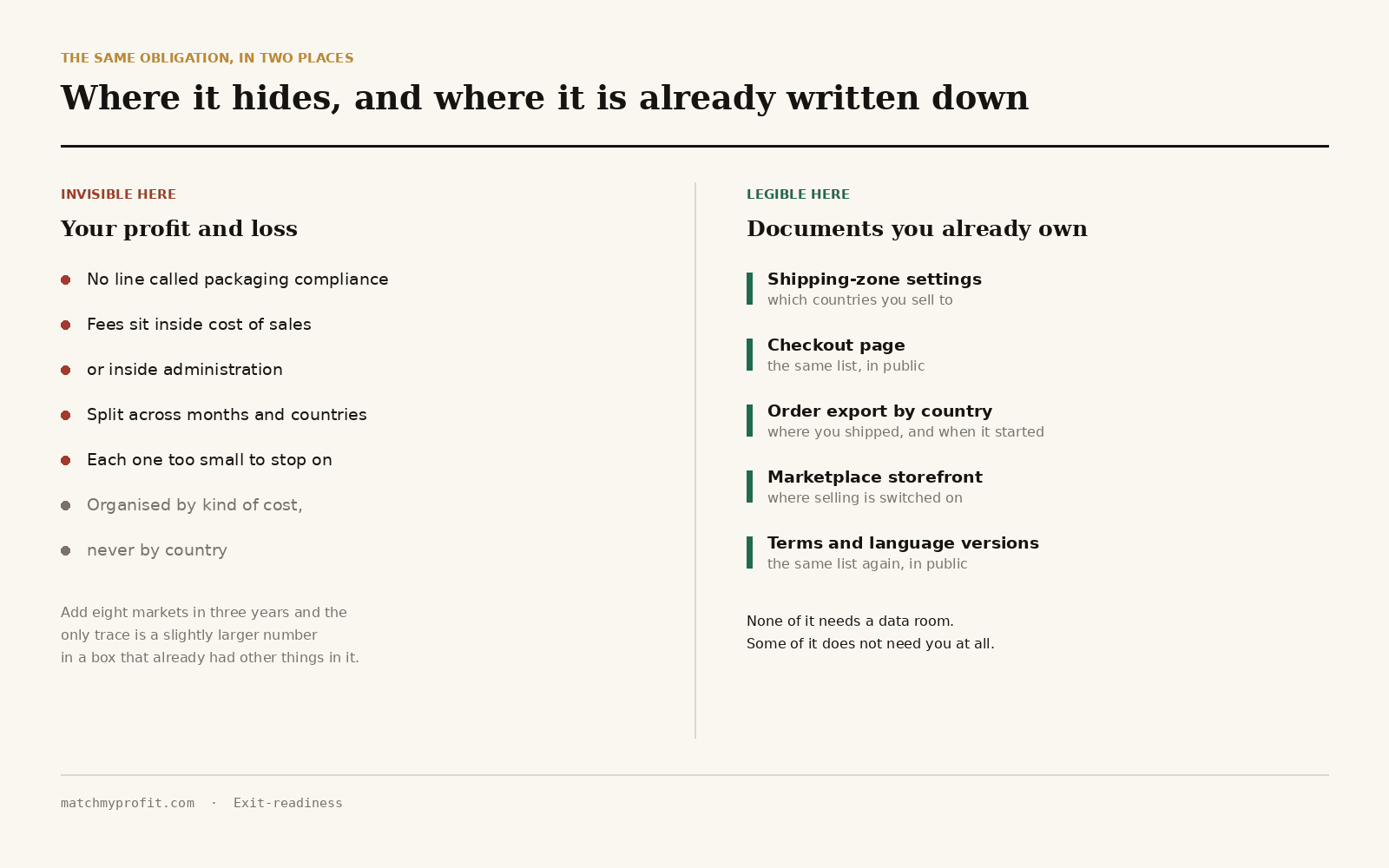
The same duty, in two places. One of them you look at every month.
Where it is legible
The same obligation is extremely easy to see in a set of documents you already own.
Your shipping-zone settings say which countries you sell to. Your checkout says the same thing to anyone who opens it. Your order export says which countries you have actually shipped to, and when the first order to each one went out. Your marketplace storefront settings say where you have switched selling on. Your terms page and your language versions say the same thing again, in public, to anybody who reads them.
None of that requires a data room. It doesn’t require your cooperation either, for the parts that are public.
That asymmetry is worth sitting with for a second, because it inverts the usual worry. Owners tend to assume the risk in a sale is what a buyer might dig up. Here, half of it is already published, by you, and the half that is not published is the half you can produce in an afternoon.
If you sell software, services or content, the packaging rules are not your subject and I’d rather say so here than let you read to the end to find out. The shape probably is yours, though. Almost every online business now carries at least one duty that grows with its footprint rather than with its revenue, sits in no single line of the accounts, and is evidenced by documents rather than by performance. Be clear about what our own assessment does with that: nothing. It asks about compliance, registrations, licences and filings of any kind exactly nowhere. What it does read is the part of your business that behaves the same way whatever you sell. How your revenue is put together, how much of the company runs through you personally, and how much of what you say about it a stranger could check. That’s the useful part for you. The rest of this page is about boxes.
The subtraction, and why it is arithmetic rather than judgement
Most findings in diligence are arguments. Somebody thinks your add-back is not an add-back, or that your growth rate flatters the last quarter, and those take days and end in a negotiation.
This one is different, because both sides of it are documents. It belongs with the things a buyer counts rather than argues about. That is why it sits in the same part of the method as revenue quality and operations. Countries shipped to, from your own export. Countries registered in, from your own record. The difference between the two lists, and the years each gap has been open.
There’s no view to take here, only a list that either matches or doesn’t.
That is why the question comes early and why it is answered quickly. It’s also why an incomplete answer is expensive out of all proportion to the money involved. A buyer’s lawyer is looking at a gap he can’t size, on a matter where the size depends on years of activity only you can evidence, and he has to write something in a report about it.
What a cost and an exposure become, in two different documents
Here is the part that turns a compliance item into a deal item, and it is the reason the fee is a distraction.
A cost that everybody can measure goes into the price. Somebody sizes it, it comes off at completion, and it stops existing.
An exposure nobody has sized cannot go into the price, because neither side knows what to put there. So it goes into the sale agreement instead, as a specific promise from you about that one subject, with its own limit and its own life. It usually has money held behind it until that life runs out. It also has a second home, in the disclosure letter, where the problem is not the exposure itself but your ability to describe it accurately in writing.
The document that hurts you is the one where you’re asked to write down what you know, and you find you don’t know it.
I’m not going to tell you what those promises usually run to, or how much of a price typically sits behind one. I don’t have a figure I can stand behind, and a plausible number is worse than none. What I can tell you is which document each outcome lands in, and that the choice between them is decided by whether you have a record rather than by what the underlying thing costs.
The retrieval, in order
You can do this part without me. It is the whole method. Do it in this order, because each step tells you what the next one is for.
One. Export your orders by ship-to country, three years, one row per country per year. This is the ten-minute job and it is the one to do before you close this page. Every platform does it. What you want is the country list and, for each country, the month the first order went out.
Two. Write the registration status beside each country. A number and a date where you have one. A blank where you do not. The blanks are the point of the exercise.
Three. Find out who actually shipped. Your own entity, a fulfilment partner, a marketplace programme. If it was somebody else, whose name is on the registration, and does that arrangement survive you selling the company. That last question is the one owners have never asked and can’t answer from memory.
Four. Put declared volumes next to shipped volumes. For the countries where you are registered, this is the second column and it is the harder one. Registration is a status. Filings are a history, and a history has numbers in it that either match your warehouse or don’t.
Five. Write down every entry and exit, dated, with the reason. You opened Poland in March because a reseller asked. You switched Sweden off because returns ate the margin. Those sentences are worth money in a data room and they exist nowhere except in your head, where they are decaying.

The order matters. Each step tells you what the next one is for.
Now look at what you have built. One dated page that answers the subtraction before anybody runs it.
Two things it also does, which are worth more than the page itself. It puts your side of the story in the disclosure letter, on your timing, rather than in an indemnity schedule on theirs. And it converts the honest gaps from things a stranger discovers into things you disclosed, which is a different category of finding entirely and always has been.
A warning about testing this on our own tool, because it is not a small one. The exit-readiness assessment asks nothing about countries, registrations, licences or filings of any kind, so it won’t find what this page has just described. The bigger problem is what it does instead. It reads spread as strength, which is right almost everywhere and wrong here. A business selling into a dozen markets, with no dominant customer and a couple of channels, will score well on revenue quality, and it will say so on screen: your revenue is durable and spread. On the axis it measures, that is true. On the axis this page is about, the same spread is what created the exposure in the first place. Countries as a concentration axis belong in the next version of the questions and are not in this one. That is a gap in the tool rather than in the method, since the framework behind it already treats the geography of revenue as something a buyer cross-checks. So read your score with this page in your hand, and read the revenue-quality line as a statement about customers rather than about countries. Take the assessment if that is useful to you.
What it costs to wait, and it is not only money
Steps one to five take an afternoon. That’s genuinely true, and I want to be careful with it, because it’s also the thing that could mislead you.
The page takes an afternoon. The years the page describes cannot be built at all. Filing history accrues at one month per month and there’s no way to buy it forward. That is the entire argument for doing this now rather than when somebody asks, and it is the same argument as every other thing worth fixing before a sale: the fix is cheap and the clock is not.
There is a second cost. In a live process it is often the larger one. A question nobody can answer does not only get priced. It sits there. Diligence moves on down the schedule and comes back, counsel wants a call, the call needs a document nobody has, and two weeks go past. Deals more often die of the delay while somebody looks for the thing you were worried about than of the thing itself.
Where this is the wrong advice
Three readers should do something other than what this page says.
If you sell in one country, this isn’t a problem you have. The whole exposure comes from the boundary crossing. One market, one obligation, and your accountant almost certainly has it.
If you are mid-process right now, be careful about what you change. Restating figures or renegotiating terms while somebody is looking reads as a change made because somebody was looking. This is different, in a way worth being precise about. Assembling a record of what already happened is retrieval rather than change. You are writing down what is already true, and doing it before their lawyer writes his own version is the strongest move available to you at that stage.
If your honest answer to step two is that every line is blank, don’t panic and don’t start a compliance programme that eats a founder-quarter. Registering now is straightforward, and it is not the part that costs you. The past is a separate question with a different answer in every country, and it is a question for somebody qualified to answer it, which on this subject isn’t me. What this page gives you is the ability to walk into that conversation with the numbers already assembled, rather than paying somebody to assemble them at their hourly rate.
One last thing, and it is the one place I’d raise my voice. Cutting a market to shrink the admin may well be the right call, but do the arithmetic before you do it and not after. Switching a country off stops the bill going forward. It removes not one of the years already behind you, so the list a buyer asks for is exactly as long as it was. And the revenue you just deleted lands inside the twelve months he models before he models anything else.
What is still moving, as at 15 August 2026
This is the only part of the page with an expiry date on it.
There is an argument running in Brussels about authorised representatives specifically: whether a producer selling into a country where it has no establishment must appoint somebody there. A suspension was proposed in December 2025. The Council did not take it forward in June 2026. Parliament’s committee position narrowed it to businesses under 49 employees and 10 million in turnover, temporary, tied to a wider reform, with a vote expected around October 2026. As at the date on this paragraph, nothing has been suspended.
Two things about that argument matter more than its outcome. It is about representatives. Registering and paying are separate duties and neither is on the table. And whatever is decided applies forward. A rule that excuses you from something next year does not un-happen the years already behind you, which are the years the subtraction counts.
If you are outside the EU and selling in, none of the proposed relief was ever going to cover you.
What a clean answer buys
The other outcome is common, unremarkable, and the one you are working towards.
The request comes in. You attach one dated page. Countries, dates, revenue by market, registration numbers, declared against shipped, and a short note on the two markets you closed and why. The question is answered the same day it is asked. It never appears in the report, never reaches the negotiation, and never becomes a promise you are still carrying two years after the money arrived.
That is the difference between an item and a non-item, bought with an afternoon.
Questions owners ask about this
Does a packaging registration gap change the price of a business?
Rarely as a line on the price. A gap somebody can measure is usually paid for on the day the deal closes, and then it’s finished. A gap nobody can measure moves into the sale contract instead, as a separate promise from the seller with a limit and an end date, so the seller keeps carrying it after the money arrives.
What does a buyer ask for when he checks EU packaging rules?
The request follows the shape of the rule. Under Regulation (EU) 2025/40, a business registers in each member state where it makes packaged goods available, so the list is built country by country and year by year. What sellers can least often show is the match between the amounts they told each country they shipped and the amounts they really shipped.
Does my marketplace handle EPR registration for me?
Under the EU packaging rules that became applicable on 12 August 2026, online marketplaces must check that their sellers have registered before listing them. The duty itself sits with the business that first makes the packaged goods available in that country. So a marketplace is usually the party asking you for the number rather than the party holding the duty for you, and terms differ by platform and by country.
If the EU relaxes the rules, does that fix past years?
A change in the law works forward. As at 15 August 2026 the argument in Brussels is about authorised representatives, which is a narrower question than registering and paying, and nothing has been agreed. Any relief that arrives would change what a business must do from that day on, and it would not undo the years already behind it.
Nothing on this page needs me. The export is yours, the subtraction is arithmetic, and the page you build is worth more in your hands than in mine.
What the exit-readiness assessment does is the neighbouring job. Three minutes, a score on how a buyer reads the rest of the business, and your three largest gaps. It won’t see the countries, for the reasons above. What it does show you is the part of the picture that decides most of the outcome: how the revenue is built, how much of the company runs through you, and how much of what you believe about the business a stranger could check.
If you sell in one country, or you finished this exercise years ago and file it every quarter, leave it. It’s free and there’s no call at the end of it.
Take the exit-readiness assessmentThe other count nobody keeps: the concentration test you pass, and the one a buyer runs
